Sister Rosetta Tharpe – The Untold History of the Godmother of Rock ‘n’ Roll
Think of the rock ‘n’ roll greats: Elvis Presley, Chuck Berry, The Rolling Stones, The Beatles. The list goes on and on. Debates over who had the greatest impact are endless, but what remains undeniable is the influence these artists had on the genre.
Yet, in these conversations and these lists, one name is rarely, if ever, mentioned. In celebrating the artists who shaped rock ‘n’ roll, the musicians who shaped them are often overlooked.
Her name is Sister Rosetta Tharpe.
A queer, Black woman who began performing as a child in the early 1920s and continued until her death in 1973. Historians and critics have widely regarded Tharpe as the Godmother of rock ‘n’ roll. Before the genre even had a name, she laid its foundation through her experimental, mixed-genre work that blended gospel, rhythm and blues and early electric guitar techniques.

Her name may sound unfamiliar, but her influence certainly is not.
Born to Perform
Sister Rosetta Tharpe was born Rosetta Nubin in Cotton Plant, Ark., in 1915. Her father was not present, but her mother, a singer and evangelist, instilled a love of music in her at a young age.
She was involved in her church choir as early as four years old and at the age of six, she and her mother moved to Chicago before touring with an evangelist troupe throughout the South.
These tours had Tharpe performing in small community churches and regional gatherings in states like Arkansas, Mississippi and Louisiana, where she was exposed to a variety of gospel styles and different ways of worship. In Chicago, Tharpe encountered the city’s growing music scene and was exposed to more secular styles of music, such as jazz and blues, which would later influence the rhythm and phrasing of her guitar playing.
Tharpe’s upbringing in The Church of God in Christ, which is known for its high-energy gospel music and worship, played a crucial role in developing Tharpe’s unique sound. The church’s encouragement of interactive worship through hand-clapping and call-and-response songs, as well as its acceptance of female preachers and performers, gave Tharpe the skillset and opportunities needed to grow her talents.
By her pre-teens, Tharpe had developed a strong stage presence and was an exceptional electric guitar player, setting her apart from other young performers. Combining the musical techniques she learned in the church and on tour, Tharpe was able to cultivate a personal performance style that would later influence both gospel and rock music.
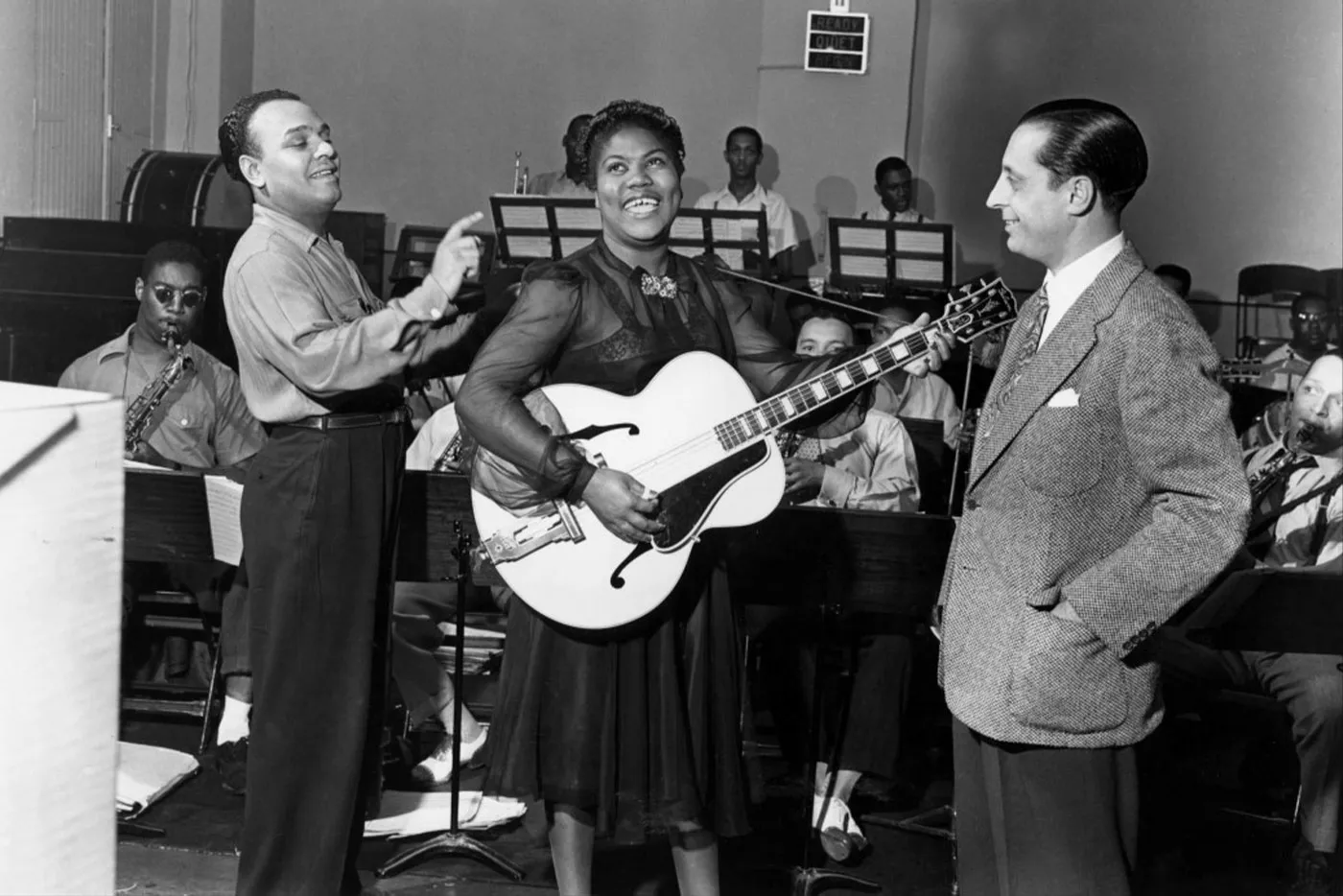
Sister Rosetta Tharpe recording at Decca Records with bandleader Lucky Millinder (left) and manager Moe Gale (right) in 1941. Credit: Courtesy of Don Peterson (via PBS)
Blurring the lines between sacred and secular
While the Church of God in Christ played such a pivotal role in developing Tharpe’s musical talent, it was also a great source of tension in her career. Jazz and blues are genres deeply rooted in Black musical expression, and yet, they were deemed inappropriate by the church. This was largely because of their associations with nightlife, dancing and secular spaces. Despite this, Tharpe was drawn to the rhythmic drive and expressive guitar phrasing in these genres. She began incorporating these elements into gospel music by the late 1930s, and she created a new sound that was grounded in spirituality but unconventional for the genre.
After signing with Decca Records in 1938, Tharpe began recording music, including “Rock Me,” drawing widespread attention to her innovative, genre-bending instrumentation. She was also one of the first to perform gospel music on a major concert stage rather than within a church, most notably when she performed at John Hammond’s From Spirituals to Swing concert at Carnegie Hall that same year. Not only did this performance introduce Tharpe to a broader audience, but it also helped her break through as a crossover artist in a time when blending these spaces was uncommon.
She continued performing gospel music in theatres and nightclubs, a choice that drew criticism from religious leaders. She also faced scrutiny for occupying male-dominated musical spaces and challenging the expectations of femininity through her volume, physicality and authority. That criticism didn’t slow Tharpe down; in 1945, she released “Strange Things Happening Every Day,” one of the first gospel songs to make it on the Billboard “Race Records” chart (now the R&B chart), reaching No. 2. Tharpe never abandoned her faith or her musical roots. Instead, she expanded the reach of gospel music through radio and commercial recordings, bringing the genre outside church venues. As a queer Black woman who existed in opposition to church norms, her refusal to conform extended beyond her performances. That being said, it’s her willingness to defy convention while remaining grounded in tradition that sets her apart from other performers and lays the groundwork for the sound that would later define rock ‘n’ roll.
Beyond the Church Walls
By the height of her early career, Tharpe was not an easily categorizable artist. She refused to separate her faith from her music, even as her music steered her into spaces where gospel music didn’t traditionally belong. Sacred music focuses on worship and devotion to God, whereas secular music is for entertainment, focusing on universal themes and the human experience. By straddling the line between these broader genres, Tharpe created something that remains true to her core beliefs but is appealing to the masses. Her mesmerizing, then-unheard-of electric guitar skills dominated the audience and the music scene as a whole.

“Can’t no man play like me,” Tharpe once said. “I play better than a man.”
She challenged the expectations of who could lead a band, who could occupy music venues and what female performers could express through their sheer musical talent. It was hard at the time for female performers to break through, let alone a queer Black woman. For Tharpe to have made such an impact not just in her time but in decades to come proves that she wasn’t just some performer. By the 1940s, Tharpe had redefined what it meant to be a gospel performer, leaving a lasting impact on the musical world even before rock ‘n’ roll had fully emerged. She spent the rest of her life performing and recording, influencing some of the biggest names in the genre until she died in 1973.
The Godmother Of Rock N Roll
When Joan Jett was just a girl, one of the original pioneers of rock as we know it today, she proudly proclaimed that she wanted to be a rockstar. To her annoyance, she was told that rock just was not for girls. There is a certain irony to knowing that the backbone of rock ‘n roll as we know it today was built by a woman.
Sister Rosetta Tharpe’s legacy stands as one of the most influential yet under-recognized architects of modern music. Emerging in the 1930s and 1940s, the fusion of gospel’s spiritual intensity with the rhythmic drive of early rhythm and blues, all while wielding an electric guitar with flair, was decades ahead of its time. Tharpe’s performances set the stage for the rock genre that would be inspired by her work.
Tharpe was one of the first musicians of every genre to create overdriven, distorted electric guitar sounds. This “dirty” tone became the foundation of rock guitar, later used by Chuck Berry, Keith Richards, Jimi Hendrix, and countless others. She achieved this by turning her amp up high and attacking the strings with force. Tharpe can also be credited with “boogie-woogie” riffs and standing bass lines. These rhythmically controlled patterns were meant to resemble the boogie-woogie piano seen in blues and jazz at the time. Chuck Berry’s signature “Johnny B. Goode” riff is a direct descendant of this style, and these riffs became the backbone of rock rhythm guitar. Tharpe was also the start of the call-response sounds from the guitar that can be seen in Steve Vai’s stage performances during his time at Whitesnake.
Her impact on rock music is impossible to overstate. She is simply the godmother of rock ‘n’ roll, despite rarely receiving her due credit for the sounds. The first Rock & Roll Hall of Famer, Chuck Berry, is often credited with the creation of the genre as we know it, along with Muddy Waters, but both artists have to admit their influence comes from Tharpe. Long before the genre had a name, Tharpe was playing distorted guitar riffs, bending notes and delivering the kind of energetic showmanship that would later define rock and roll. Even Keith Richards of The Rolling Stones has cited her as a foundational influence. In many ways, the DNA of rock music — its swagger, its rhythm, its electric edge — can be traced directly back to her innovations.
You Should Have Seen Her Standing There
The Beatles, who grew up studying American music and attempting to copy it during their early days in Germany and Liverpool, were deeply influenced by the artists who had already been shaped by Tharpe’s sound. That is not to say they simply liked her or “they were just inspired by her, you can actually directly hear the Tharpes’ signature style within their songs. Two of the Beatles’ most notorious early songs, “Twist And Shout” and “I Saw Her Standing There” are direct descendants of the cutting electric tone and fast, percussive strumming heard in Tharpe’s “Up Above My Head.” George Harrison mirrors her trebly tone, and the band as a whole is a reflection of her gospel-rock sound. One of the best-known Beatles’ songs, “I Want To Hold Your Hand” uses the boogie-woogie guitar sounds that Tharpe defined decades earlier in the genre. Rock fans love to proclaim the Beatles as the best of rock ‘n’ roll, definers of a genre, white saviours of music – and while they were responsible for the change in recording processes and design of modern sound within the booth, they do not hold a candle to the true face of the genre. Perhaps if she had been born a man with a different complexion, she might get the credit she deserves.
The Legend Lives On
Today, Sister Rosetta Tharpe’s legacy continues to resonate across generations of musicians and fans. Her induction into the Rock & Roll Hall of Fame in 2018 helped bring overdue recognition to her role as a pioneer, but her cultural impact extends far beyond awards. She opened doors for Black artists, women guitarists and anyone daring enough to blend sacred and secular sounds. During Black History Month, celebrating Tharpe means acknowledging the roots of rock music and honouring the Black woman whose genius shaped one of the most influential genres in modern history.